


Only 8% of NJ Teacher Prep Programs Get Top Marks For Preparing New Teachers To Teach Reading
June 9, 2026
Every Year 100% of These Charter School Students Graduate on Time and Go To College
June 11, 2026New Report: New Jersey Is Failing To Teach Reading Effectively. Fixes Here.
Newark Superintendent Roger Leon is making headlines crowing about the academic growth of Newark district students but there is no hiding from the data: In the city’s traditional schools only 30% of fourth graders are proficient in reading, which, according to a new report from the National Council on Teacher Quality (NCTQ), means 70% of New Jersey’s largest district’s fourth graders “are four times more likely to drop out of high school, increasing their risk of lower lifetime earnings, higher unemployment, and involvement with the criminal justice system.”
That’s not all on Leon and the Newark Board of Education. New Jersey has the dubious honor of being among the bottom 12 states in the country for holding our teacher preparation programs accountable for training prospective teachers how to effectively teach reading.
In 2024 NCTQ published a list of the necessary policies to ensure a state’s workforce can implement scientifically-based reading instruction and sustain it over time. Here are the results for NJ (which are unaffected by our new literacy laws):
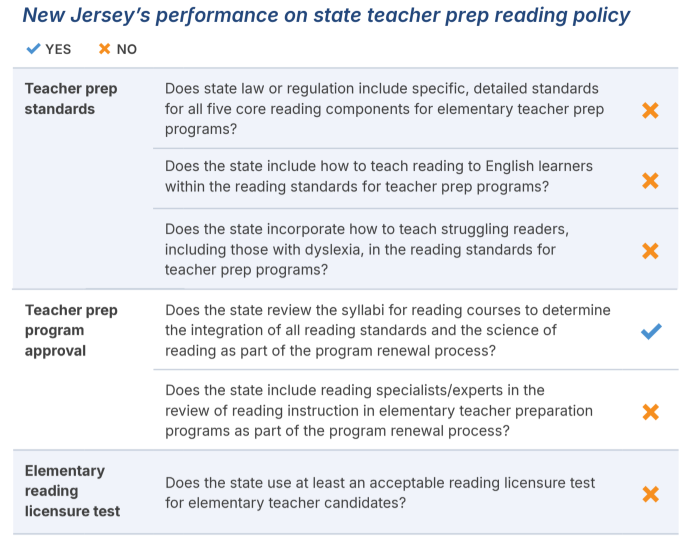
New Jersey’s literacy rate tells the tale: According to the most recent statewide data, fewer than half of fourth graders reach grade-level proficiency. Yet, says NCTQ, “more than 90% of students would learn to read if they were provided strong reading instruction.”
What is getting in our way? Does ensuring new teachers are ready for prime time require a Department of Education that is less deferential to local control and more likely to issue explicit and clear directives rather than easy-to-ignore guidance?
NCTQ President Heather Peske answers, “absolutely.” In an email interview Peske explains,
“When states prioritize teacher preparation as a critical lever to improve teacher capacity and student reading outcomes, we have seen transformation with teacher prep programs revising their courses in a relatively short period of time.”
As examples she points to Indiana and Ohio “where the state departments of education took very seriously the provisions in their new state laws that said that teacher prep programs—all of them across the state—had to align to the evidence base on how they teach reading.”
What happens when state DOEs create a more muscular culture and hold programs accountable? “Within just a few years, from 2023 to now,” Peske says, “we saw that programs across both Indiana and Ohio made significant changes and now are highly aligned to the reading research and to the state standards—and substantially far ahead of other states. The determining factor ultimately came down to state law that codified requirements for teacher prep programs and state leadership to review and hold the programs accountable.”
As the report says, “strong state policies and leadership make a difference.” One can surmise if the New Jersey DOE muscled up with “codified requirements,” “state leadership,” and accountability, we could emerge from the bottom of the pack.
Right now that necessary cultural shift, which extends well beyond teacher prep programs, doesn’t appear to be on the table. That is why, according to NCTQ’s ratings, 23% of the state’s teacher preparation programs get C grades, 23% get Ds, and 54% get Fs. Only 8% get an A. From the report:
“The state should ensure that all programs authorized to endorse teachers for state licensure are aligned to scientifically based reading instruction. Holding prep programs accountable is particularly important to vulnerable student groups like English learners and struggling readers, including students with dyslexia, whose needs are too often unmet.”
New Jersey is also called out as one of three states (the other two are New York and Illinois) where high numbers of programs refused to respond to NCTQ’s survey; in NJ, 58% refused:
“Although Illinois and New Jersey have enacted reading legislation aimed at promoting scientifically based reading instruction,” NCTQ says, “the policies do not address teacher preparation or specify how preparation programs should improve. Absent additional policy levers—such as stronger preparation standards and more rigorous program approval requirements—states have limited capacity to identify weaknesses, enforce accountability, and drive meaningful improvement.”
More generally, states that are committed to ensuring their teacher preparation programs actually prepare new teachers to teach will do the following:
- Set specific, explicit, and comprehensive preparation standards.
- Use the program review process to ensure that all prep programs are aligned to scientifically based reading instruction.
- Prevent teacher preparation programs from teaching contrary practices.
- Adopt a high-quality reading licensure test.
- Reinforce the importance of attending to the needs of vulnerable students.
- Do not let programs hide from accountability—especially noncooperative public programs.