


State Board Update: Is Camden Raising Custodians or Collegians?
August 5, 2026
Teacher Salary Differentials: Their High Costs and Unclear Benefits
August 17, 2026BARONE: The Late Arrival of New Jersey’s Test Scores Isn’t the Only Problem
An Opaque Process for Defining Academic Achievement Is Too
Dr. Charles Barone is a Senior Fellow at the National Parents Union. He resides in South Jersey with his wife and two children, both of whom attend a public middle school. This was originally published on his Substack.
The release each year of the results of New Jersey’s annual summative Student Learning Assessments (NJSLA) is an unpredictable and shambolic process. School districts generally get student test results in August or, maybe, early September. Parents, for some unexplained reason, don’t get a report on their children’s scores until a month later.1 The issuance of statewide reports has varied over the years, but in 2024 and 2025 they came in December.
This year is shaping up to be even more complicated and confusing. That’s because this spring marked the first official administration of the state’s new adaptive ELA and math assessments (known as the NJSLA-A).
In a video posted on YouTube by NJDOE in March, the state explained the new tests and said that it would release 2025-26 scores in “the fall.” Late last month, the state said scores would not be released until “December.”2 Does that mean December merely starts the usual staggered process i.e., initial release to LEA’s in December, followed by the typical one-month delay to parents (January), and then 2-3 months later (March or April) for the statewide report? Or will the sequenced rollout happen more quickly? We simply don’t know.
Some wonder whether New Jersey is trying to minimize scrutiny or blunt the political impact of disappointing or dubious results by burying them in a pre-end-of-year-holiday release when fewer people are paying attention. Maybe that’s what’s happening. Maybe it isn’t. It’s hard to tell because the process is opaque.
To its credit, NJDOE has offered a technically sound explanation for the delay. Before scores can be released, psychometricians must analyze how individual items perform, writing responses must be scored (by hand at this stage of development), and new achievement levels must be established.
I’m willing to give the state and our new-ish Governor, who is sending better “responsible and conscientious leader” vibes than her predecessor, the benefit of the doubt for now. But the doubt component of that equation comes in part from the fact that, as the parent of two New Jersey public middle school students, I can say that neither the state nor our local school district did much to directly communicate with us why the assessment was changing, how adaptive testing works, or why score reports might be delayed for months.
The lack of transparency here is a potential red flag. Because we also need transparency about how the state plans to go about defining different levels of student achievement.
Should the state designation that a student “met expectations”3 mean a student is performing solidly at grade level? On track for college and careers? Demonstrating minimum competency? Or is it defined through less principled criteria?
These decisions are hard enough to make on the merits but they are also fraught with political implications. A higher cut score that raises the standard for meeting expectations may be admirable but it also could produce lower statewide proficiency rates that put public schools in a less favorable light. A lower cut score can make student performance look more favorable but it comes without even an iota of change in what students know and are able to do.
This is not an imaginary concern. A number of states in recent years have lowered their cut scores to inflate proficiency rates in places as wide ranging, geographically and politically, as Alaska, Florida, Illinois, Kansas, New York, Oklahoma, and Wisconsin.4
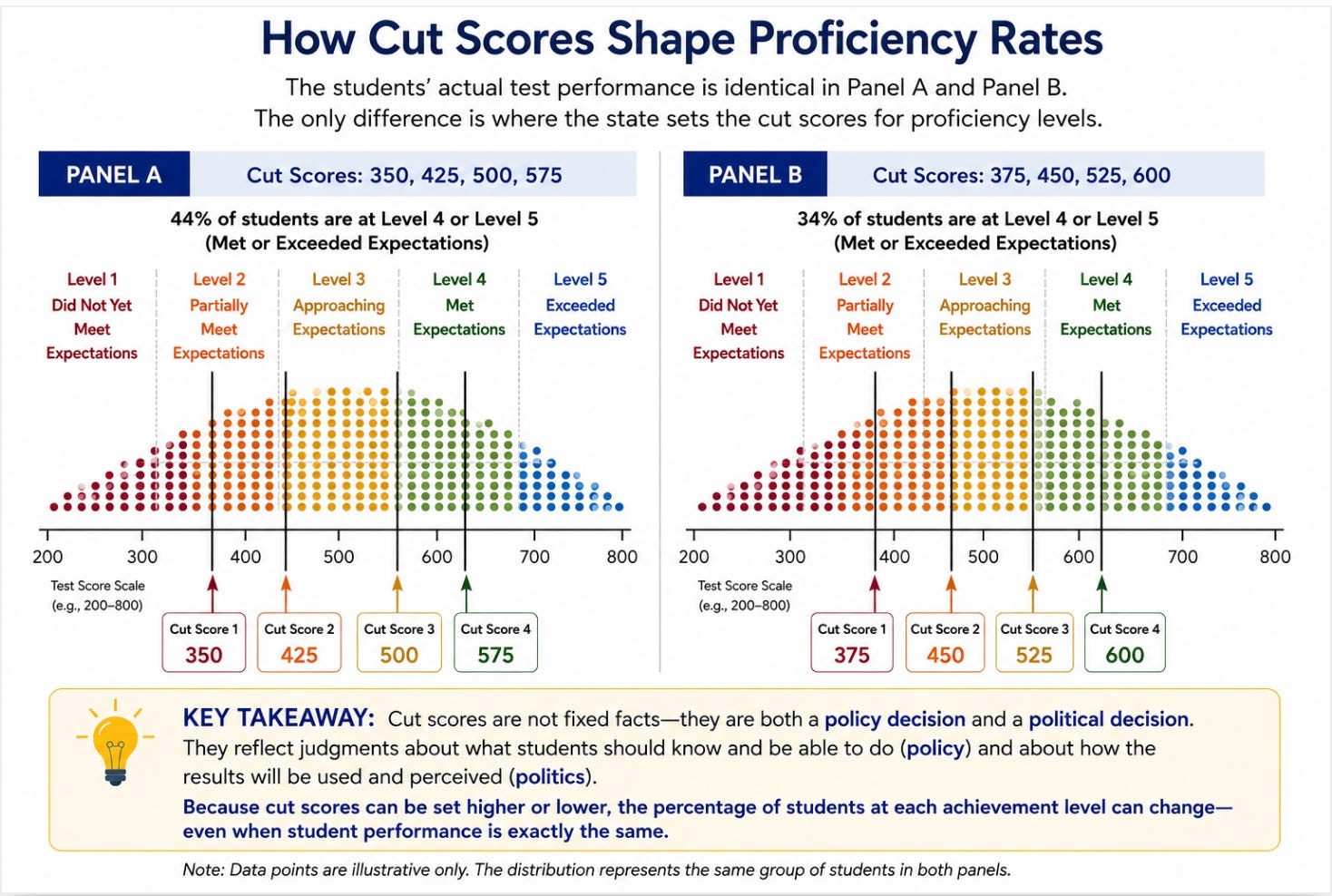
This means that the setting of “benchmarks” i.e., how different levels of performance are defined, demands close public scrutiny. In a state that has long celebrated itself as having one of the nation’s best school systems, but where recent NAEP results and a sluggish post-pandemic recovery have raised questions about whether that status is still warranted, those decisions inevitably carry political weight.
NJDOE does offer, in addition to the video cited above, a set of FAQ’s on the new test on their website. They give good descriptions of what adaptive assessment is, the different item types, and what needs to be considered in new test development.
But there isn’t much information on how the test will be finalized other than a mention that “educators” have been and will be involved. I also was able to find on both the NJDOE and the NJEA websites announcements that the state was seeking “educators for statewide assessment committees.” But I can’t find anything else about whether these committees include anyone other than educators nor can I find a final list of names of members.5
The state, in short, has done a good job on explaining the “what” of new assessment development (though it does require one to do a bit of hunting). But it also should answer key questions about how decisions will be made in finalizing the NJSLA-A:
- What evidence is being considered?
- How will we know if the state keeps its promise that new achievement levels will be made comparable to previous years?
- How will the state distinguish changes in student learning from changes in the measurement system?
- Are groups other than educators and the psychometricians from the testing company – parents, civil and disability rights groups, researchers, business leaders, institutions of higher education – involved in the process?
- What safeguards exist to ensure that public relations considerations don’t influence how achievement is defined?
- How will the new tests better inform what now seems to be a fairly lackluster state accountability and school improved system?
New Jersey should at the very least publish the names and qualifications of those serving on its assessment technical advisory committees. If those committees don’t have wide participation from anyone other than educators, including people not employed by the system that is being evaluated, then committee membership should be broadened. The state should explain, in plain English, how cut scores will be set and seek public input on draft standards before they are finalized. It should make at least some of its meetings public. And it should release technical documentation alongside parent-friendly summaries.
I’m not in any way accusing the state of bad faith here. Like I said, I’m willing, for now, to give this Governor and this NJDOE the benefit of the doubt. At the same time, state officials shouldn’t expect the public to just blindly trust them. They should show us the process and make any necessary changes to improve it in a way that makes that trust warranted.
1Unless one is lucky enough to know someone on the inside who shares them with one first 😉
2Technically, 2/3rds of December is fall but most people heard “fall” as roughly October
3The NJSLA-A ELA and Math will have five performance levels:
- Level 1 – Did Not Yet Meet Expectations
- Level 2 – Partially Meet Expectations
- Level 3 – Approaching Expectations
- Level 4 – Met Expectations
- Level 5 – Exceeded Expectations
4The passing score for the state’s high school graduation test, the NJGPA, was lowered from 750 to 725 in 2023 and an increase in graduation rates naturally followed.
5As a point of comparison, Federal law requires the National Assessment Governing Board for the National Assessment of Educational Progress to have 26 members appointed by the U.S. Secretary of Education, reflecting a specific balance of diverse educational and public roles and demographic diversity e.g.,
Governors and Legislators: Two current or former governors from different political parties, and two state legislators from different political parties.
Education Officials: Two chief state school officers, one local school superintendent, one state board member, and one local board member.
Educators and Staff: Three classroom teachers (tested grade levels), two curriculum specialists, three testing and measurement experts, two school principals (one elementary, one secondary), and one nonpublic school administrator.
Public and Business: One business/industry representative, two parents not employed by any educational agency and two general public representatives not employed by any educational agency.