


Weak Math, Weaker National Defense
October 19, 2026New Report: New Jersey Is One of the Two Worst States for Effective Math Instruction
Today the Center for Reform in Public Education (CRPE) released its fifth annual “State of the American Student” report, which focuses this year on effective strategies states can take to improve outcomes for students in literacy and math.
New Jersey comes off as average in reading instruction but one of the two worst in the country in math.
The timing for the report is important, for the Garden State and elsewhere. Nationally, recounts CRPE, only 10.5% of students attend school districts that have fully recovered to 2019 math and reading performance since the pandemic. That’s on top of proficiency levels falling below where they were in 2013 and widening achievement gaps. Thus, CRPE asks, “what are states doing to meet the moment, and are their efforts likely to work?”
After all, it’s all on the states: For the last 13 years, since No Child Left Behind, for all its flaws, withered into Every Student Succeeds Act, the federal government no longer exercises meaningful accountability over state systems. CRPE analysts explain that the education politics and policies of individual states are largely determinative of school systems. “If state officials cannot say what they are trying to achieve, they cannot be held to it, nor can schools.” In a section that seems tailor-made for NJ, they continue,
“Every state needs a strong, coherent, evidence-driven strategy. A literacy law is not a strategy. A funding increase is not a strategy. With a strategy, a state’s goals, infrastructure, and accountability fit together into something coherent enough to move outcomes. By this standard, most states come up short.”
CRPE calls this lack of urgency a “national emergency,” with states settling for “inaction and inconsistency” instead of meaningful changes to math and literacy instruction, career-connected learning, and state guidance on AI.
It doesn’t have to be this way. In a few states — Alabama, Louisiana, Mississippi– education leaders are clear about their goals, have implemented effective policies with close follow-through, and are able to shimmy past partisan battles by making student learning the primary focus. CRPE has a scoring system that gives points for strengths (methodology in the appendices at the end of the report). Each goal is scored from 1-4 for each state.
With a close eye on the strengths and weaknesses of New Jersey’s strategies, as evaluated by the team at CRPE and supplemented by state profiles from ExcelinEd, here are the top takeaways from the report.
- Only 13 states have set “time-bound, strongly signaled goals tied to specific numeric outcomes for student learning” that are easily accessible to families. For example, South Carolina, which gets 4 points in this category, explicitly says by 2030 at least 75% of students will be at grade level in reading and math. NJ gets 2 points because, while it expresses the goal of raising achievement, it is “nonspecific” about what that means.
- New Jersey is comparatively average in its implementation of key principles in literacy. According to ExcelinEd, NJ has implemented 7 of 18 best practices in literacy, or 11%. Only eight states have implemented all 18: Alabama, Arizona, Arkansas, Florida, Georgia, Mississippi, North Carolina, and South Carolina.
- Math is a weak spot for many states but NJ is at the bottom of the heap: Just NJ and Wisconsin have partially implemented only one of 11 principles (requiring all students to take Algebra 1 by 9th grade). For a deeper dive into NJ’s weaknesses in math instruction, go here.
(Did you know there is a Science of Math? There are seven priorities: foundational numeracy, universal screening, data‑based decision‑making, systematic and explicit instruction, high‑quality instructional materials, targeted intervention, and professional learning aligned to math education research.)
The report also delves into the politics of K-12 education, which is inseparable from state priorities and, apparently, commitment to best practices. Here’s CRPE:
“Passing and implementing education policy is a political endeavor. Increasingly, these efforts are also politically polarized, and this growing polarization is linked to evidence of problematic effects on student outcomes and teacher retention. For this reason, we investigated state policy adoption along partisan lines.”
Yes, every state wants student literacy rates to improve. But whether that state can aggressively implement reforms has a lot to do with whether that state is red or blue. (That’s not the only difference: red states are focused far more on school choice and blue states on student well-being.)
Math too: “The same partisan split shows up more starkly in math. Of the 18 states that have enacted math bills since 2022, 13 are red (54% of all 24 red states), three are purple (23% of 13 purple states), and two are blue (15% of 13 blue states).”
It will come as no surprise that one reason for lack of implementation is dissent from teacher union leaders, who are far more powerful in blue states like NJ. This is not destiny: CRPE finds a few blue states that have embraced key reforms, even with the support of unions. Yet the divide remains, which leads to other questions:
“States are operating with fundamentally different theories of what needs to happen to improve education, and both sides of the partisan debate are facing fundamental problems. How will red states square aggressive instructional reforms with expanding unregulated private school markets funded with public dollars? Can lower-performing red states actually achieve top-performing status without investments in broader child well-being? How will blue states deliver big promises about academic improvement without enforcing evidence-based instructional practice and incentivizing progress? Will blue states with strong unions be able to advance more comprehensive reforms with real consequences, including changes to teacher evaluation that unions generally oppose?”
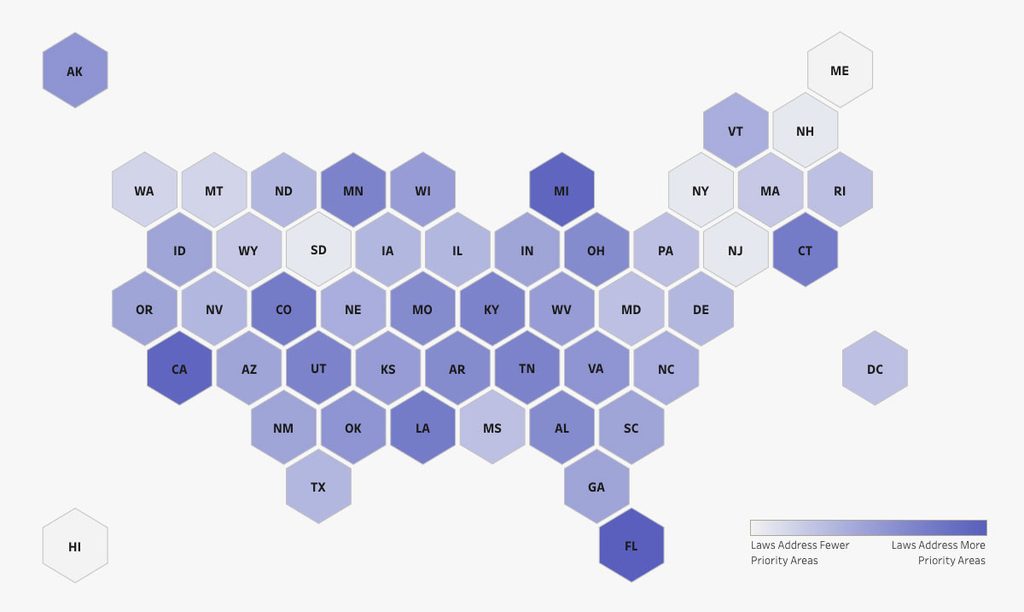
Here is a map from the Shanker Institute that visualizes how far states have gone in updating state-of-the-art literacy instruction. Red states are far ahead of blue states. (Also see page 34 of the CRPE report, which ties those states to union politics.)
The report concludes with five recommendations to all states to “reverse the two troubling trends of declining national achievement and growing variation in student outcomes between states”:
- State leaders: Audit your current improvement strategy, patch its holes (especially in math and AI), and focus on implementation.
- Funders and advocates: Hold states accountable for improvement strategies and follow-through to achieve their goals.
- National leaders: Over time, reimagine and reestablish the role of the federal government.
- Political organizers and strategists: Rebuild a genuinely bipartisan coalition for evidence-driven reform.
- Researchers: Grow the evidence base for effective, strategic state leadership.
Our kids can’t afford for us to wait.