


Why Is This Charter School Claiming An Opening That Doesn’t Exist?
November 9, 2026Is the NJ Ed Department Throwing Years of Student Learning Data in the Trash?
Earlier this month the New Jersey Department of Education presented statewide test scores in reading, math, and science from last spring’s 2026 assessments. Fifty-one percent of students met expectations in reading, 41.7% did in math, and 25% did in science, results that NJ Spotlight describe as “a sobering reality [that] all that funding has done little over the last decade to move the needle in overall proficiency rates and the persistently wide gaps between the state’s highest- and lowest-scoring student groups.”
This is an important message for parents, for the general public, for teachers, for school leaders, and for legislators: Once one looks past inflated report card grades, our state school system is not providing students with the skills they need to succeed in college and the workplace. Yet one detail in the DOE’s presentation has not received the attention it deserves and goes to the heart of whether NJ is using data from the tests in a way that can help us move that needle.
Last year, during multiple presentations, the public was assured that results from this year’s tests — newly adaptive, i.e., the difficulty of the questions changes based on student’s answers – would be comparable to previous years’ assessments. This is important: Without that ability to look at data longitudinally — i.e., make long-term analyses of student progress —- we’re throwing years of information on student learning into the trash. Was last year’s $15 million spent on high-dosage tutoring, for instance, a good investment? This should be a question with an available answer but there is none if we can’t compare new scores to previous years.
But all of a sudden, based on last week’s presentation, we’re being told the adaptive tests are not comparable and we are starting with a “new baseline.”
NJ Ed Report has asked the DOE for clarification. The DOE has not responded at the time of publication; we will update if we hear anything.
New Jersey parents – the public in general — need to trust our standardized assessment systems to accurately reflect whether students are learning and whether interventions are paying off. As the Data Quality Campaign says, once states “have done the hard to build these systems, establish relationships, and develop policies that support their ability to use this data,” they can use the information “to answer critical policy questions and support continuous improvement.”
Over the years, the DOE has worked hard to build assessment systems. Last year, during updates on the adaptive assessments, we were assured new test data would be comparable with old test data, giving us the necessary information to“ “answer critical policy questions and support continuous improvement.”
From a presentation last spring:
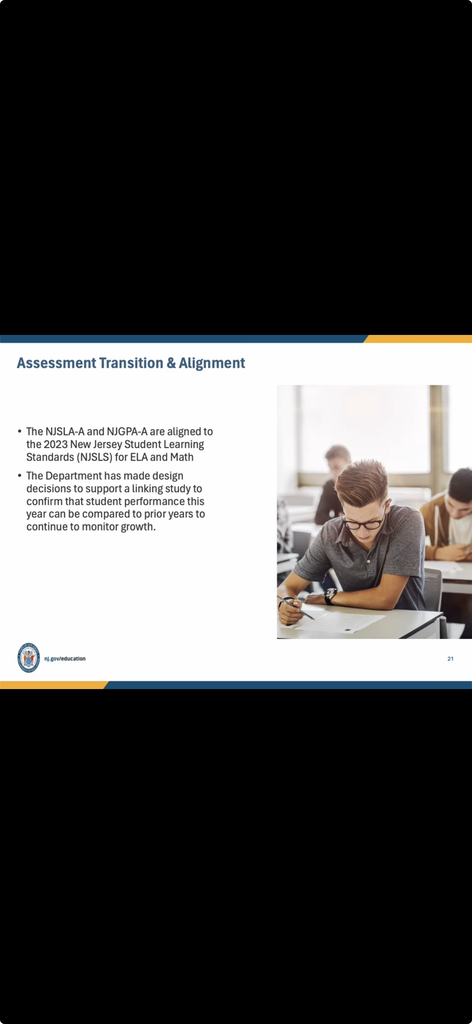
From a transcript of a public presentation:
“The department has prioritized the need to maintain the ability to compare tests from year to year and made intentional design decisions to ensure we can compare this year’s test to last year’s. The design of this test supports a linking study which will confirm that student performance this year can be compared to prior years to continue to monitor growth and not lose the trend line.“
From the DOE’s response to a OPRA request last spring from the indefatigable John Migueis:
“Following adoption of the cut scores, linking studies will ensure that NJGPA-A and NJSLA-A results can be compared to the non-adaptive NJGPA and NJSLA results from prior years. The linking studies are anticipated to be completed before the release of the statewide NJSLA-A and NJGPA-A results. “
So, yes, we can use the student results from the new tests to compare results from previous years. All good! In fact, the DOE has made this a priority!
Or, never mind. From the presentation last week: “Because multiple components changed for English Language Arts and Mathematics simultaneously, 2026 results establish a new baseline and should not be directly compared with prior years.”
This is not esoteric trivia. Let’s say you are a parent who wants to assess whether student growth and proficiency in a particular district is moving in the right direction. Right now you can go to the DOE’s School Performance Reports, choose a district or a school, and then click your preference. Once you do, on the left side of the page you can choose from a variety of areas and look at student learning over the last four years (and, if so inclined, you can go further back). For instance, here is the information for Princeton Regional Public School District’s “NJSLA ELA and Math Results” from 2021-2025, broken down by grade. If the new tests were as promised, parents would be able (eventually) to see the bar chart for 2026. Without the continuity of comparability, we’re in the dark about trends in district performance.
In other words, either the results can be compared to previous years or they can’t. If they can’t, what changed? Did the Murphy Administration’s DOE get it wrong? Were there changes in the contract with Cambium, the private vendor? Was there a problem with the implementation or the results of the adaptive testing? Was the public inadvertently misinformed?
Stay tuned.