

New Jersey Doesn’t Need a Task Force to Fix Absenteeism. Start With Teacher Attendance.
January 20, 2026
Lt. Gov. Dale Caldwell Tourns NJ Tutoring Corps’ World-Class Tutoring Center
January 22, 2026Does Gov. Sherrill Get What’s Happening in Montclair?
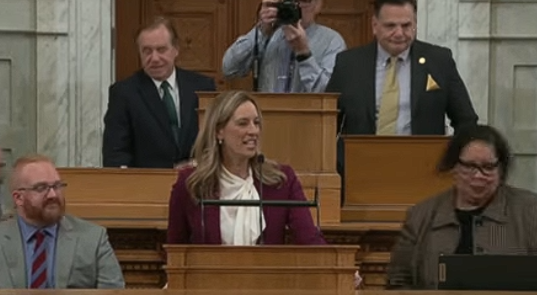
New Governor Mikie Sherrill, a resident of the hipster paradise of Montclair, recently shared her belief that New Jersey parents can buy their way into great school systems. In reference to everyone’s shock at the $20 million budget shortfall in her hometown, one that may lead to state intervention, Sherrill told the Montclair Pod, “The deal is you pay these taxes so that you get a great education for your kids.”
This perception that high spending leads to high outcomes for kids– a core message of school funding lobbyists– is failing to hold up in Montclair. Currently annual property tax rates there run about $21K, median house prices are $1.2 million, cost per pupil is $27,000, and the average teacher makes $88,016. Therefore, many parents like Gov. Sherrill conclude, that outlay guarantees sky-high school quality. As she said earlier in her campaign, “New Jersey has the second best public school system in the country. We proudly invest in our students and teachers.”
But do we really get what we pay for, not just in Montclair but in other suburban idylls? Does input (costs) correlate with output (student learning) in a wealthy district where kids tend to start on third base? Let’s stick with looking at actual student performance in Montclair.
According to the NJ Department of Education, Montclair students’ math and reading proficiency rates are firmly in the slightly-higher-than-average range. While most students out-perform state averages, they don’t do as well as you’d think. For instance, 31% of fourth graders can’t read at grade level and 33% can’t do math. Just 43% of Montclair students meet course expectations in Algebra.
It is far worse for kids of color who show stark achievement gaps: last year 44% of Black students were “graduation ready” in Math, compared to 80% of white students.
Yet how would families know? Even Gov. Sherrill falls for the vibes, in large part because the New Jersey State Board of Education, under former Gov. Phil Murphy, has lowered the bar for measuring student proficiency. (Lots of states have since the U.S. Congress changed the federal education law to weaken accountability, but not every state claims a “top in the nation” status.)
Witness the flash of honesty a year and a half ago when the State Board of Education (at the urging of the DOE) lowered the proficiency scores eleventh graders need to get on the high school graduation test: Henceforth, NJ high school diplomas no longer signify “college and career-readiness” but instead a (tautological) “high school graduation-readiness.”
When word leaked of this plan, Senate Majority Leader Teresa Ruiz, then head of the Senate Education Committee, said setting such a low bar “makes me cringe” because it sets such low expectations for student proficiency.
Then there is what Morgan Polikoff calls the unintended consequences of rampant grade inflation — a national predicament that renders opaque parents’ perception of their kids’ academic progress — which is “gutting our collective knowledge of how well kids are doing in school.”
He describes“the cultural pressure to be kind and lenient to students by offering them unlimited makeups and refusing to hold the line on high expectations.” The result, he says, is “grades provide less and less useful information, which is a disaster with so few other data points to use.”
Some parents see through the pretense. (Check out various reddit threads like this one.) In The 74, Kevin Mahnken describes a new study showing “the families of the highest-performing K–12 students, and those with access to greater resources, increasingly disaffiliate from traditional public schools.” Indeed, the seven private schools in Montclair enroll close to 2,000 students, or 24% of the district’s 6,000-student enrollment. (From another reddit thread: “If you really value high level academics, and have the funds, which you probably do if you can afford Montclair, you send your kids to private schools.”)
If Montclair’s fiscal mismanagement leads to parents questioning the effectiveness of their school systems, even those as highly prized as Montclair, if parents stop relying on report cards to assess student progress and look to objective evaluations, if New Jerseyans start demanding more accountability and transparency from all levels of our educational bureaucracy, something good might yet come of this mess.
(Photo by Anne-Marie Caruso/New Jersey Monitor)