

NJ Tutoring Corps Celebrates Its First Cohort of Tutor Apprentices
July 8, 2026
When NJ Tenure Rules Hurt Kids: Lessons from Asbury Park
July 13, 2026BENNETT: NJ’s Local Fair Share Isn’t ‘Fair’
Jeffrey Bennett is a long-time observer of NJ state aid. He is currently a member of the South Orange-Maplewood BOE, but he writes this in his individual capacity as a citizen. The opinions herein are only his own and do not represent anyone else.
The 2026-27 school year year is the eighteenth year in which New Jersey’s K-12 school aid is governed according to the School Funding Reform Act, a landmark law signed by Jon Corzine in 2008 and eventually fully funded in 2024-25.
Despite SFRA being titled a “reform” law, no “reform” is permanent, and voices are growing louder to “reform the School Funding Reform Act.” Most demands are higher state spending targets, mechanisms to tamp down year-to-year fluctuations, a more precise way to calculate Special Education funding, and a restoration of state aid to districts that lost aid in the last few years.
Those proposed reforms have some validity, but I believe that the biggest flaw in SFRA is one that has gotten no attention: its bizarre way of calculating Local Fair Share, where “fairness” is anything but equal treatment.
What is Local Fair Share?
Local Fair Share is simply the amount of taxes a district is supposed to be capable of paying to support its schools. For a poor district, it will be very little and the district will get a large amount of state aid; for a rich district it will be very high and the district will get minimal state aid.
The calculation of Local Fair Share is critically important in the calculation of Equalization Ai, the most important state aid stream, under the formula:
Adequacy Budget – Local Fair Share = Equalization Aid
So, the concept of Local Fair Share is basic, but New Jersey makes the calculation of that “fair share” very complicated.
New Jersey, among a handful of states, bases half of Local Fair Share on a district’s Aggregate Income and not just its taxable property (ie, Equalized Valuation), even though taxable property is the only thing a Board of Education has the power to tax.
For 2026-27, the formula for Local Fair Share is:
(Equalized Valuation x 0.013677750 + Aggregate Income x 0.055930804)/2
Because of the use of Aggregate Income to calculate Local Fair Share, there is not an equal tax rate for Local Fair Share under SFRA. Although the weighted average for Equalization Aid-eligible districts is 1.37%, the amount that districts are expected to pay ranges from a 0.99% tax rate to a 1.89% tax rate for Equalization Aid-eligible districts in 2026-27 and theoretically even higher for districts who are ineligible for Equalization Aid.
To give an example of the disparities here, compare Haddonfield and Asbury Park.
Haddonfield and Asbury Park have almost identical Equalized Valuations at $3.14 billion and $3.13 billion respectively, but Haddonfield’s Local Fair Share is $69 million (a 2.19% tax rate!) versus Asbury Park’s $36 million, a 1.15% tax rate. Haddonfield is thus ineligible for Equalization Aid. If all NJ districts paid a common 1.37% tax rate, Haddonfield would be eligible for $5.3 million in Equalization Aid.
Why Haddonfield’s tax rate is so exceptionally high is likely due to some high-income outlier(s) living there and whose incomes are part of Haddonfield’s Aggregate Income. Why Asbury Park’s tax rate is so low is certainly due to so much of its property being owned as vacation property or commercial, which has no associated income.
The incorporation of Aggregate Income into the calculation of Local Fair Share thus advantages towns that have significant non-residential and vacation home property, since non-residential property and vacation homes have no permanent residents and thus no income attached to them. On average, a year-round residence worth $500,000 housing a couple earning $150,000 would increase a district’s Local Fair Share as much as a commercial property worth $1 million.
Because of this bias against districts with non-commercial property, there is a correlation between having a high Local Fair Share and higher municipal taxes, which is contrary to any principle of equity.
Note: although I’ve referred to high-income outliers in speculating about Haddonfield’s extremely high Local Fair Share, a household doesn’t have to be that rich to depress their districts Equalization Aid. Any household whose income is 36x times their school property taxes is a net negative for their school district, meaning, their income reduces state aid by an amount that is greater than what they pay in school taxes. At NJ’s average household school tax of $5,500, a couple living in an average house in an average town would only need to earn $200,000 a year to hurt their district.
The original justification for using Aggregate Income to calculate Local Fair Share goes back to 1990 and was apparently to have low-cost parts of New Jersey subsidize high-cost parts of New Jersey, although, according to Deborah Jaffe’s “Other People’s Children,” it was seen entirely in regional terms, ie a way to prevent a “skew” towards South Jersey.
Since Jim Florio was from South Jersey it is shocking that he would knowingly hurt South Jersey, but the evidence undeniably shows that using LFS requires Philadelphia suburbs to pay the highest tax rates, and therefore there probably was an intention to prevent a “skew” to South Jersey.
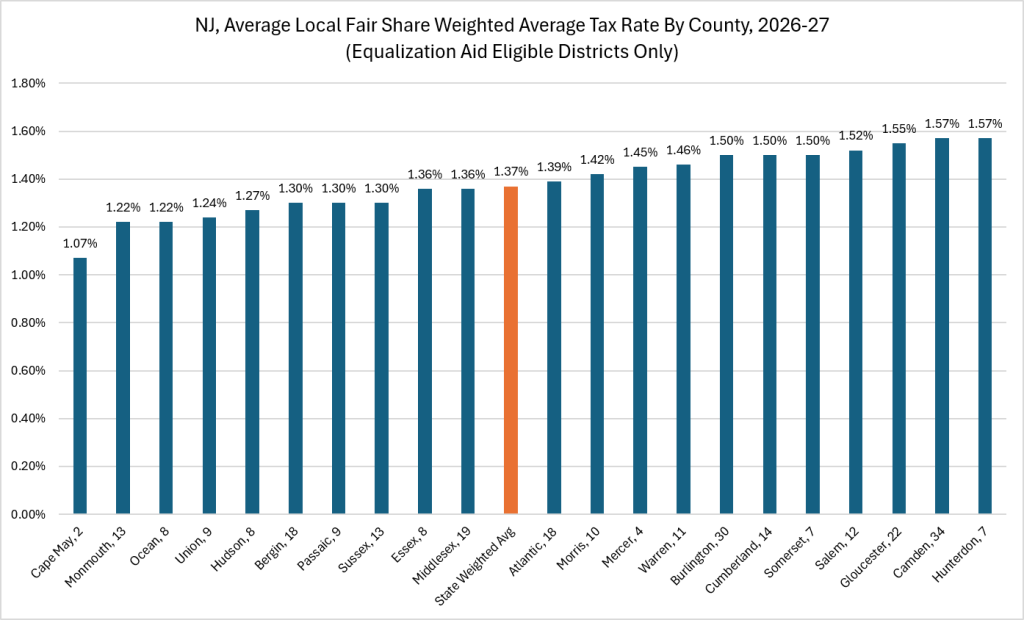
Some readers may think that it is justified to have low-cost places subsidize high-cost places (I disagree), but until SFRA passed in 2008, New Jersey did not have Geographic Cost Adjustments. These now increase state aid in high-cost counties and decrease state aid in low-cost counties (through Adequacy Budget increases or decreases), so SFRA’s bias against south and rural New Jersey is more intense than what existed in older generations of NJ’s state aid laws.
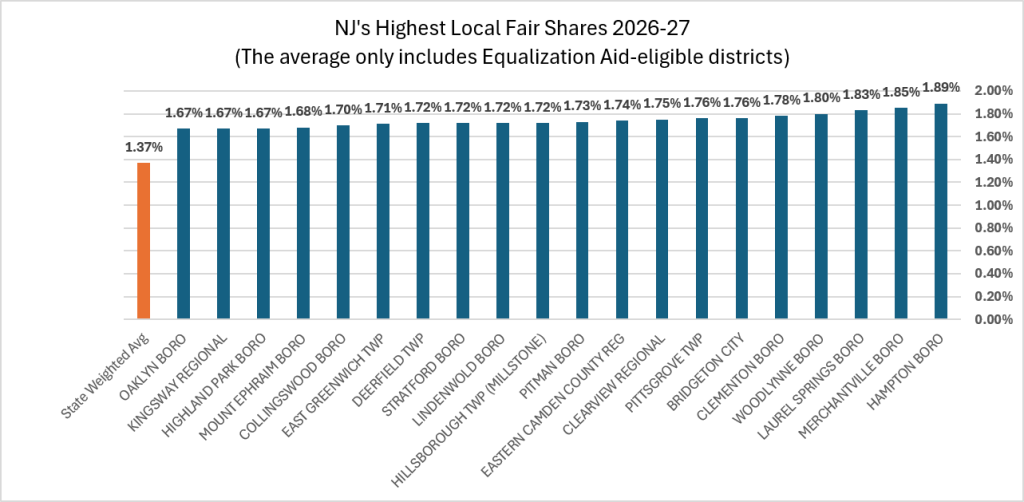
Some readers may assume there is a progressive benefit to using Aggregate Income to calculate Local Fair Share, since they know that low-income people tend to have to stretch more for their housing; they imagine that helping districts with low income:property value ratios helps poor districts.
But despite the tendency of low-income people to spend more for housing relative to their incomes, there is no benefit to low-wealth districts.
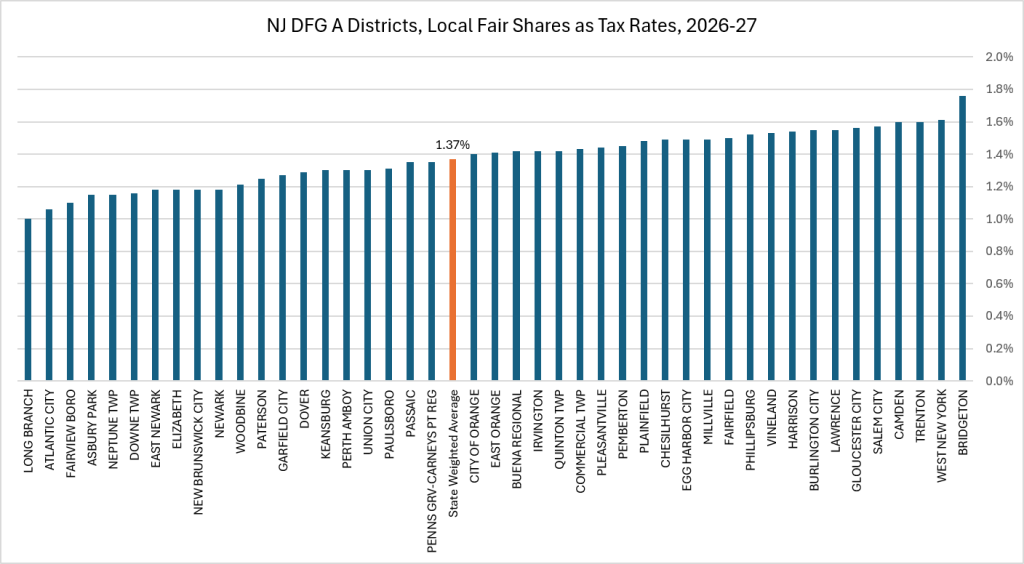
The Local Fair Shares of NJ’s DFG A districts are usually above the average.
And to reiterate the same point that using Aggregate Income has no progressive result but with the Abbotts, most of their Local Fair Shares are average or high too.
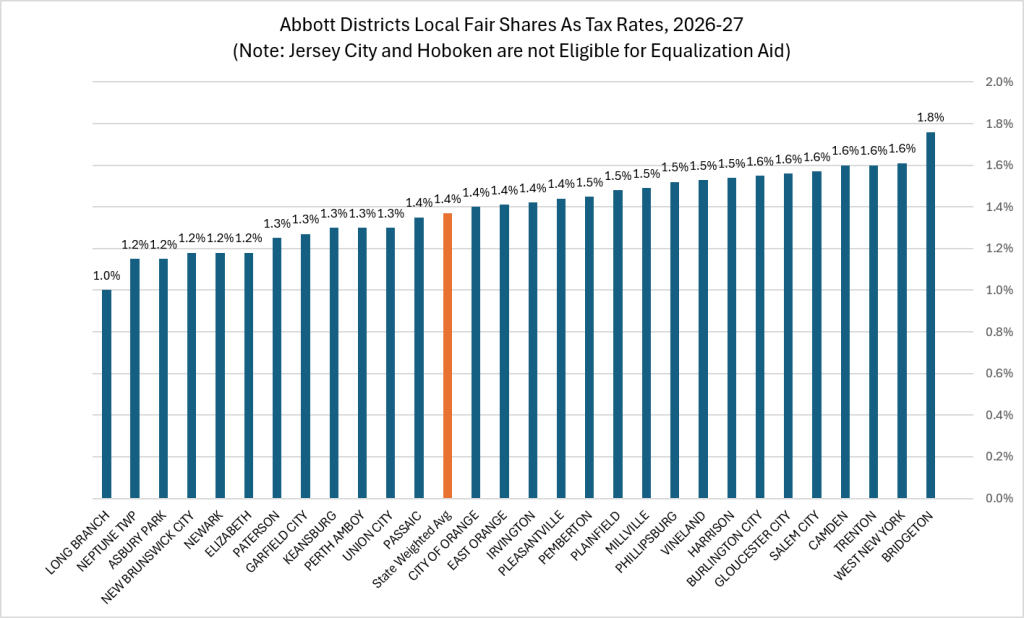
So, again, there is no pro-equity benefit to how NJ calculates Local Fair Share.
Who are the beneficiaries of this system?
The usual beneficiaries are towns at the Jersey Shore and towns in northern NJ that have a lot of commercial property. Newark’s Local Fair Share is rather low, but it is not representative of high-poverty districts.
It is surprising that Local Fair Share inequality isn’t a higher profile issue. Although the president of the West Orange Board of Education has criticized NJ’s method of calculating Local Fair Share, he is an outlier. Even the Philly-area districts that are hurt the most by it do not make this a cause. Neither do rural areas, despite those same rural areas running a low-key fight to flatten or eliminate the Geographic Cost Adjustments. Those who criticize SFRA for its complexity do not address the complex way Local Fair Share is calculated, even though it is a major facet of that complexity.
But NJ’s method of calculating Local Fair Share isn’t something we should accept as a given. It intentionally creates inequalities in property tax rates that we do not accept in other circumstances. NJ strictly uses Equalized Valuation to apportion county taxes, without any modification for different types of property or different income:property ratios.
Perhaps fully eliminating Aggregate Income is not politically possible, but it should be possible to shift the division from 50:50 to something more weighted towards Equalized Valuation or to cap tax rates at a certain ceiling. Let’s hope that districts that are hurt by the Local Fair Share formula and representatives who care about the principle of equal treatment can push this onto the state aid reform agenda.