

New Report: NJ Offers Teachers No Extra Pay for the Hardest Jobs to Fill
September 29, 2026New Jersey Knows How To Improve Learning Outcomes. What Is Stopping Us?
The National Council on Teacher Quality just released a report on whether states are using best practices to strengthen teacher compensation. NCTQ’s conclusions are sharply critical of New Jersey because we haven’t implemented commonsense reforms like paying teachers more for taking on the most challenging positions, not awarding extra pay for Master degrees (piles of data show the credential has no impact on teacher effectiveness), and awarding merit pay to our most effective teachers. Coincidentally, one day earlier the NY Times surveyed 37 top education academics and researchers to rate a range of ideas for improving student achievement, looking at both effectiveness and cost.
One New Jersey-specific overlap from these analyses: we are far away from implementing effective, data-driven, and affordable strategies to improve outcomes for students. This failure is largely responsible for dreadful schools like Newark’s Dr. E. Alma Flagg School, where 3.5% of third graders read at grade level, Asbury Park’s Bradley Elementary, where 8% of third graders meet grade-level expectations in math, and Trenton Public Schools, in the backyard of the Statehouse, where only 6% do. Even in high-flying Princeton, 38% of third graders don’t read proficiently and 25% can’t pass math. Yet we treat teachers, as TNTP’s 2009 landmark report explained, like interchangeable widgets, insulting to the majority of teachers and bad for kids.
(Need more proof? Read Pulitzer Prize-winning Nikole Hannah-Jones’s viral piece called, “In Fighting for Every Black Child, Did I Betray My Own?”, which gives us a clear view of what happens when teacher effectiveness and accountability are kicked to the curb–teachers don’t assign homework, show up in class, or respond to parents–and when student expectations are lowered in the name of equity but merely perpetuate pretense and lack of learning. It is not about funding: the school Hannah-Jones ended up sending her daughter to, PS 307 in Brooklyn, spends $52,349 per student per year.
The most effective and uncostly strategies for school improvement, according to the analysts surveyed by the NY Times, are accountability and the use of high-quality instructional material. Also highly rated are high-dosage tutoring and strict implementation of the science of reading. NJ’s record is mixed: we have new laws on using explicit, systematic reading instruction and more use of high-dosage tutoring but quality varies district to district because our Department of Education doesn’t enforce the use of either due to both our addiction to local control and NJEA’s resistance to reform. These inconsistent efforts go back to our lack of accountability from the top. . For instance, the Murphy Administration weakened accountability for student learning, redefined “proficiency” to make NJ schools look better than they are, and got caught up in culture wars.
The bottom line is we fail to incorporate data-driven improvements to our school system, one where kids graduate high school with diplomas handed out like participation trophies and where about half of college students require remedial coursework. That’s why student growth has stalled: we now rank 20th out of 38 states in academic growth in math and 19th out of 35 states in reading.
What initiatives could Gov. Mikie Sherrill and Commissioner Lily Laux collaborate on in order to “focus on increasing academic rigor for more students”?
From the NYT (emphases its own):
“Pay effective teachers more to work at high-poverty schools, a strategy that is not widely used but can help encourage the best teachers to work with students who are most behind.” (See NCTQ study for confirmation.)
“School accountability — giving schools a rating, like an A-F letter grade, and requiring underperforming schools to make changes — emerged as highly cost effective.”
“Offering more access to advanced classes was another cost-effective idea.”
“Allowing high-performing charter schools to expand.”
But no idea will work if the focus isn’t on quality and consistency. “In practice, simply doing anything well may matter more than any handful of interventions,” said Marguerite Roza, director of the Edunomics Lab at Georgetown University, adding “Implementation is everything.”
A few other notes:
- NCTQ lists four states that offer at least a $5K supplement for teachers willing to teach in hard-to-staff schools. One of them is Texas (others are Alabama, Hawaii, and Utah). Our new commissioner, Lily Laux, was formerly Deputy Commissioner of School Programs in Texas, which offers some hope if she is able to migrate that initiative east, especially as NJEA’s sway in Trenton has been weakened by its wastrel attempt to use $45 million in teachers dues to try to push its former president Sean Spiller into the Governor’s Office. (NJEA opposes all these reforms.) See here for more about the success of merit pay in Texas.
- A little history: NJ came close during the Christie Administration to reforming tenure laws through a series of proposed bills (see here) to “put children first and protect teachers.” The Legislature did pass a bill called TEACHNJ, engineered by Democratic Senator Teresa Ruiz, that included more accountability for teachers, evaluations partially based on objective measures of student proficiency, and limits on lifetime tenure. The reforms (except one: it takes four years to get tenure instead of three) were whittled away due to the Murphy Administration’s obsequious posture towards NJEA lobbyists.
- So much great analysis out there about Hannah-Jones’s article. Scroll to the bottom of Mike Petrilli’s substack for a partial list. Two teasers: Roland Fryer: “What matters isn’t only how much money reaches a school, but what happens after it arrives.” Andy Rotherham: “Nor does [Nikole Hannah-Jones] show much curiosity about the structural causes of the ineffective teaching she so candidly describes. Here’s a hint: it might be a teachers’ contract that makes it hard to fire a dangerous teacher, and harder still to remove one who is merely ineffective at teaching. Hannah-Jones is strikingly incurious about all of this, perhaps because getting into it contradicts easy narratives about both the causes of the problems and the possible solutions and creates an acute political dilemma for center-left and left-leaning folks many prefer to just avoid.”
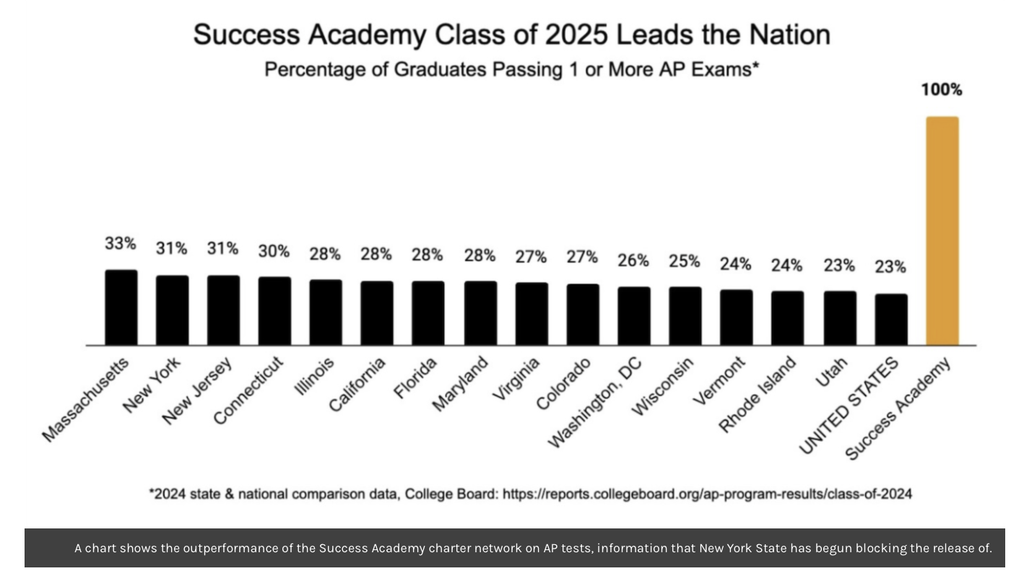
- Also, as others have pointed out, if Hannah-Jones was so invested in sending her daughter to a low-income NYC public school with mainly black students, why didn’t she look at charter schools? Majority-black Success Academy, where student achievement dwarfs even NYC elite schools despite an enrollment of 73% low-income students, even has a school in Brooklyn. Yet she never mentions them.
There is so much good information out there. Now if only New Jersey would learn from it.