

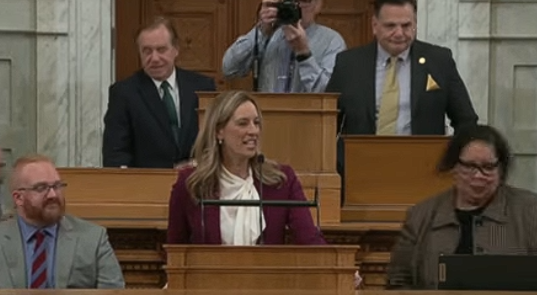
Here Is What Gov. Sherrill Plans For K-12 Education During Fiscal Year 2027
March 10, 2026
As Other States Move Forward, Will New Jersey Leave Education Dollars Behind?
March 16, 2026Does Sherrill Have the Muscle To Overcome the Pitfalls of Local Control?
Lately there has been much attention paid to the Southern Surge — students in states like Mississippi, Louisiana, Alabama, and Tennessee who are overcoming higher rates of poverty and demonstrating more academic growth than New Jersey students, among others. While there are multiple reasons for these states’ divergence from a national trend of educational stagnation, one important one is a recognition that capitulation to local control, as compelling as it is in a state like NJ with 600 school districts, can get in the way of what’s best for kids.
While the four states mentioned here are hardly uniform in their politics (and education is always political) and all, to some degree, honor local control, they have Legislatures and state education agencies that aren’t afraid to be prescriptive in their oversight of school districts. And that’s not just a Republican thing: Louisiana, from 2016-2024, had a Democratic governor, John Bel Edwards.
Louisiana is a good study in contrast (although it has the advantage of having only 69 school districts, not 600). When Covid hit, NJ let schools choose their own school opening adventure, with Gov. Phil Murphy proclaiming in August 2020, “we rely upon the work of local educational communities to determine the best way for their schools to reopen.” (In response, Montclair, Scotch Plains-Fanwood and South Orange-Maplewood parents sued their districts for bowing to the demands of local teacher union leaders who fought for continued remote instruction.) It wasn’t until September 2021 – almost 18 months after Covid hit— that Murphy ordered a full reopening.
Taking a different approach, Louisiana ordered most schools open by August 2020. Here is Sen. Cleo Fields, D-Baton Rouge, chair of the Education Committee: “Getting our students and teachers back into the classroom in the safest, most efficient manner is our top priority.”
There is a proper balance between respecting home rule and accepting oversight from the state. New Jersey has yet to find it.
And while we don’t have a pandemic right now, we do have a learning crisis, with many New Jersey students failing to make up ground, despite our high per pupil cost. According to the most recent state data, half of New Jersey students can’t read at grade level and 60% can’t do math. There are many reasons for this: lower standards, lax accountability, grade inflation (which hides actual student academic growth from parents), chronic absenteeism, student overuse of edtech,* those lengthy school closures. But there is also our adherence to local control, along with its correlative, a DOE, State Legislature, and Executive Branch that eschew top-down educational mandates.
So, Louisiana. The state once ranked 49th in the nation in fourth grade reading and now clocks in at #15 (despite spending only $13,800 per pupil annually almost half as much as NJ spends). It was recently touted as “the only state where fourth-grade reading scores showed a significant increase compared to 2019.” In math, students also showed “significant improvement, in the top five for math growth.”
What can we learn? That a muscular state education agency less deferential to local control can provide students with well-trained teachers, high-quality curricula, and high standards.
In a new piece for Watershed Advisors, Jessica Baghian, formerly Assistant State Superintendent and Chief Academic Policy Office for Louisiana’s DOE, outlines levers that were used to overcome not only Covid-inflicted learning loss but a long history of underperformance in a state where 28% of students live in poverty, twice as many as in NJ. Baghian singles out “‘local control’” for being shorthand for ‘there’s not much the state can do.’” And when that happens, she continues,” it can unintentionally limit a state’s ability to drive change at the classroom level.”
Sound familiar?
Sure, the NJ DOE can’t tell teachers which books to choose (not that we’re choosing many books) but “the state absolutely has a responsibility to define what strong instruction looks like, ensure materials meet that bar, and build the support systems that help teachers deliver it well.”
Baghian includes a chart of what the Louisiana’s DOE did, based on a strategic plan called “Louisiana Believes.”
What jumps out?
- The state goes well beyond federal accountability rules that require state ed agencies to identify the 5% lowest-performing schools. In Louisiana they identify 40%. (In NJ we do do the minimum, 5%.)
- The state raised standards for proficiency, unlike NJ, which lowered them. Louisiana also increased the rigor of state standardized tests (and gets the results into parents hands by early July). Their DOE adjusted its accountability system to target both grade-level achievement and growth, and required 400 schools to create corrective action plans.
- Louisiana places guardrails around how schools spend federal money to “incentivize” districts to use high-quality instructional material and to devote afterschool funding to high-dosage tutoring. It also created a “marketplace” to ensure district instructional materials were data-driven and first-rate. (Teachers were involved in rating these programs.)
- The state put restrictions on professional development, mandating that all PD be focused on math and reading instruction, as well as special education.
(An elephant in the room: Louisiana has one of the weakest teacher unions and NJ has one of the strongest, with NJEA leaders chafing at any threat to local control and generally opposing increased rigor and accountability. For instance, during the Murphy Administration, the NJEA served, for all intents and purposes, as the regulatory arm of the DOE, leading the way to lower standards for proficiency, emasculated teacher evaluations, longer school closures, and way too much time spent on side issues like gender orientation.)
Does the Sherrill Administration have the muscle to turn things around?
In an interview at NJ Spotlight, Julie O’Connor wonders, with reference to our new Education Commissioner, Lily Laux, late of Texas, “what will the Sherrill administration do if certain districts do not choose programs that are considered evidence-based? Will the Sherrill administration penalize those districts by withholding funding? That’s something that we saw in Texas, which used carrots and sticks to ensure that districts were in line with the latest research.”
These are questions we should all be asking.
There are no quick fixes. Well before Covid, Louisiana has adhered to what Ed Reports calls a “long-term, systemic commitment to high-quality instructional materials (HQIM), strong accountability measures, and teacher-led curriculum reform.”
But we’ve got to start somewhere, right? Isn’t it time to learn from states that have found the balance between throwing up their hands at the obstinacy of local control and doing what’s best for kids?
*Jared Horvath attributes part of Louisiana’s (and Mississippi’s) success with learning recovery to their rejection of “edtech” — a preoccupation with one-on-one devices in classrooms– and a conscious choice to double down on low-tech standards-based instruction.