


Here Is What Senator Kim Gets Wrong About Asbury Park
February 25, 2026
Wake Up Call NJ Launches New Campaign Urging DOE To Release Students’ State Test Scores By June
March 3, 2026Is It Time for Our New Ed Department To Buff Up?
Last week Mike Petrilli asked a state education leader why school districts in his state weren’t swiftly adopting high-quality reading materials that were proven effective in southern states as well as England. “Why not use the muscle of the state agency to speed things up?,” he queried.
“Because my state isn’t like Louisiana,” he said. “We’re a local-control state. I can’t just tell districts what to do.”
New Jersey, like this unnamed state, is a local-control one too. Last week Julie O’Connor, in “Is Home Rule Sabotaging Reading Reform,” makes the cogent argument that New Jersey’s “strong deference to local decision-making” undermines statewide efforts to reform the way we teach kids to read. While other states require school districts to, for instance, choose one of several state-approved reading programs, NJ defers to individual school boards who may or may not move on from discredited forms of reading instruction like “balanced literacy” and “three-cuing.” “Anything that is centrally driven from the Department of Education runs into this allegiance to localism,” notes Chris Cerf.
There are tons of examples of NJ districts expressing recalcitrance to top-down mandates: state tenure and teacher evaluation laws, superintendent salary caps, sex education regulations, state standardized testing, Common Core standards,etc.
But what if new Education Commissioner Lily Laux took some of the lessons she gleaned from her former post in Texas and pushed back on NJ’s addiction to local control by mandating some commonsense interventions within our laissez faire landscape?
Two examples: In Texas, the DOE requires districts to pick one of several approved programs aligned with the science of reading. If a district refuses to pick one of them, it loses some state money. In New Jersey, the DOE provides a list of “recommendations” that include high-quality, data-driven programs but after that a district can do what it wants. (From a recent report at ExcelinEd: “New Jersey DOES NOT require school districts to adopt high-quality instructional materials aligned to the science of reading and state standards.”)
In Texas, all teachers pursuing certification in pre-K through 6th grade are required to take a highly-rated “rigorous science of reading exam.” They can retake the exam up to five times but unless they pass it they don’t get certified. Prospective teachers in NJ, according to the National Council on Teacher Quality, take “a weak test that does not adequately address the science of reading.”
So let’s start simple: what if the DOE mandated districts adopt high-quality reading programs and required teachers to prove their understanding of how children learn to read?
Sure, that’s a change from the toothless, if well-intended, guidance currently on the DOE’s website. And no doubt district fiefdoms will resent the intrusion.
But what if we just talk about kids?
New Jersey and Texas are very different states; we have half as many students living in poverty and less than half as many multilingual learners. Yet one of the values of national data is our ability to compare student outcomes, regardless of state wealth or education politics and policy. Urban Institute took student proficiency scores from the highly-regarded NAEP tests and adjusted them for demographics.
For fourth graders in New Jersey, the demographically-adjusted score for the 2024 NAEP was 214.2. For Texas fourth graders, the adjusted score was 218.7. NAEP regards this difference as statistically significant.
Here’s a better way to look at it. Below is a chart created by Chad Aldeman that plots 4th grade NAEP scores with Education Law Center’s spending figures per student. (NJ’s average spending per pupil is about $24K; Texas’s is about $13K.)
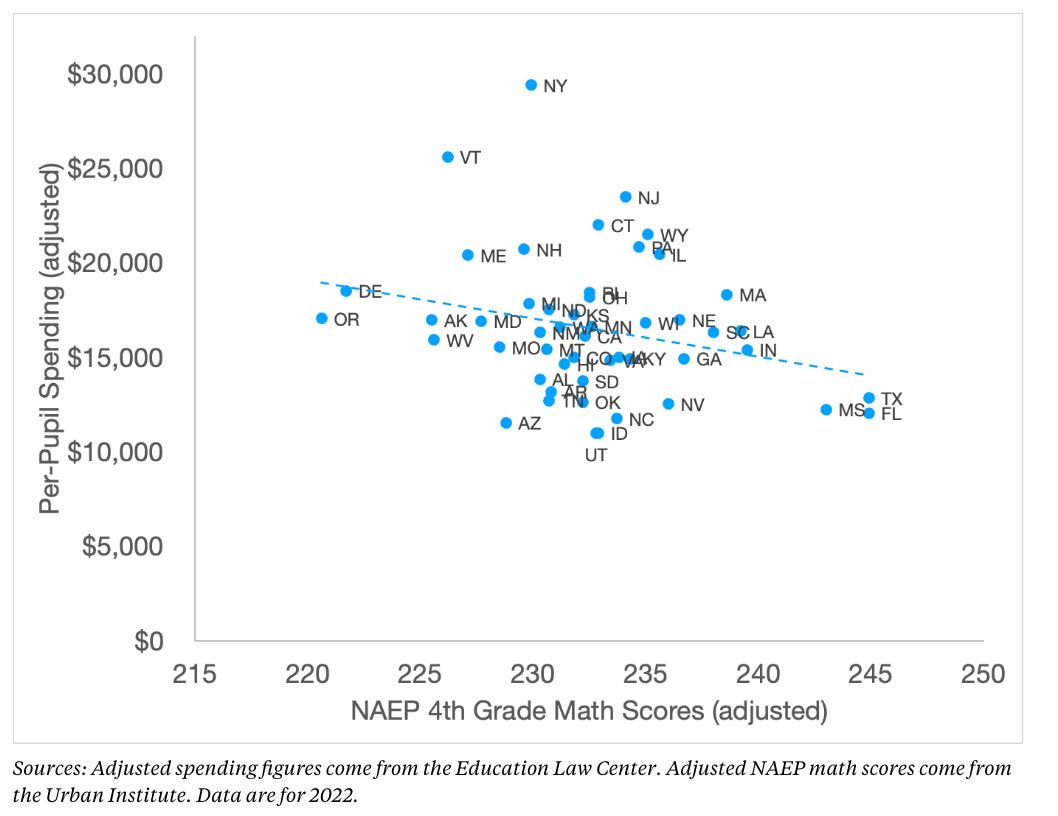
Bottom line: Texas students, through top-down mandates and despite less money to spend, outperform NJ students in reading proficiency.
Is it that fantastical to imagine NJ school leaders applauding a more muscular DOE? Recall during Covid school closures when the DOE blew its responsibilities in spectacular fashion by not setting out clear guidance, superintendents were apoplectic.
Can NJ take a tip from Texas (which, in fairness, doesn’t have a teachers union approaching NJEA’s clout) and set rules in place for teaching reading and math? Can Dr. Laux graft some of Texas’s acquiescence with state mandates onto NJ’s rabid municipal madness?
A chink in district autonomy just might help more New Jersey students learn how to read.