


EXPLAINER: The Panels You’ve Never Heard Of — And How They Decide School Funding
February 17, 2026
The Adequacy Illusion — When “Costing Out” Replaces Outcomes
February 24, 2026NJ Districts Are Running Out of Money. Case Study: Newark
From Montclair to Hackensack to Perth Amboy to Jefferson Township, we hear regular reports of school districts running out of money, sometimes due to lax fiscal oversight (Montclair) but mostly due to hiring too many staff members with short-term federal Covid relief money. Districts throughout New Jersey, as well as through the nation, will now have to “right-size” an unsustainably large workforce, especially given decreases in student enrollment.
With a tool called WANDA developed by Georgetown University’s Edunomics Lab, you can look up your own school district and see the number of employees added between 2018-2025 juxtaposed with changes in student enrollment. Staff are divided into teachers, paraprofessionals, non-teaching certified staff, administrators, and transport/food services.
Let’s look at Newark Public Schools (NPS), NJ’s largest district, with an annual operating budget of almost $1.6 billion. (About $1.4 billion comes from the state.) In addition, the district received more than $280 million in ESSER funds, or federal Covid money intended to be used for learning loss from lengthy school closures. The district was recently in the news because, according to TAPinto, Superintendent Roger Leon has been boasting about increases in enrollment — “we’re the one school district in the entire country had the highest student enrollment growth,” he told leaders at a recent gathering— but, in fact, “last month, Newark Public Schools announced that student enrollment had declined by 818 students, marking the first drop the district has seen in over five years.”
Let’s see what WANDA has to say about NPS and the fiscal predicament it faces now that the Covid money is gone.
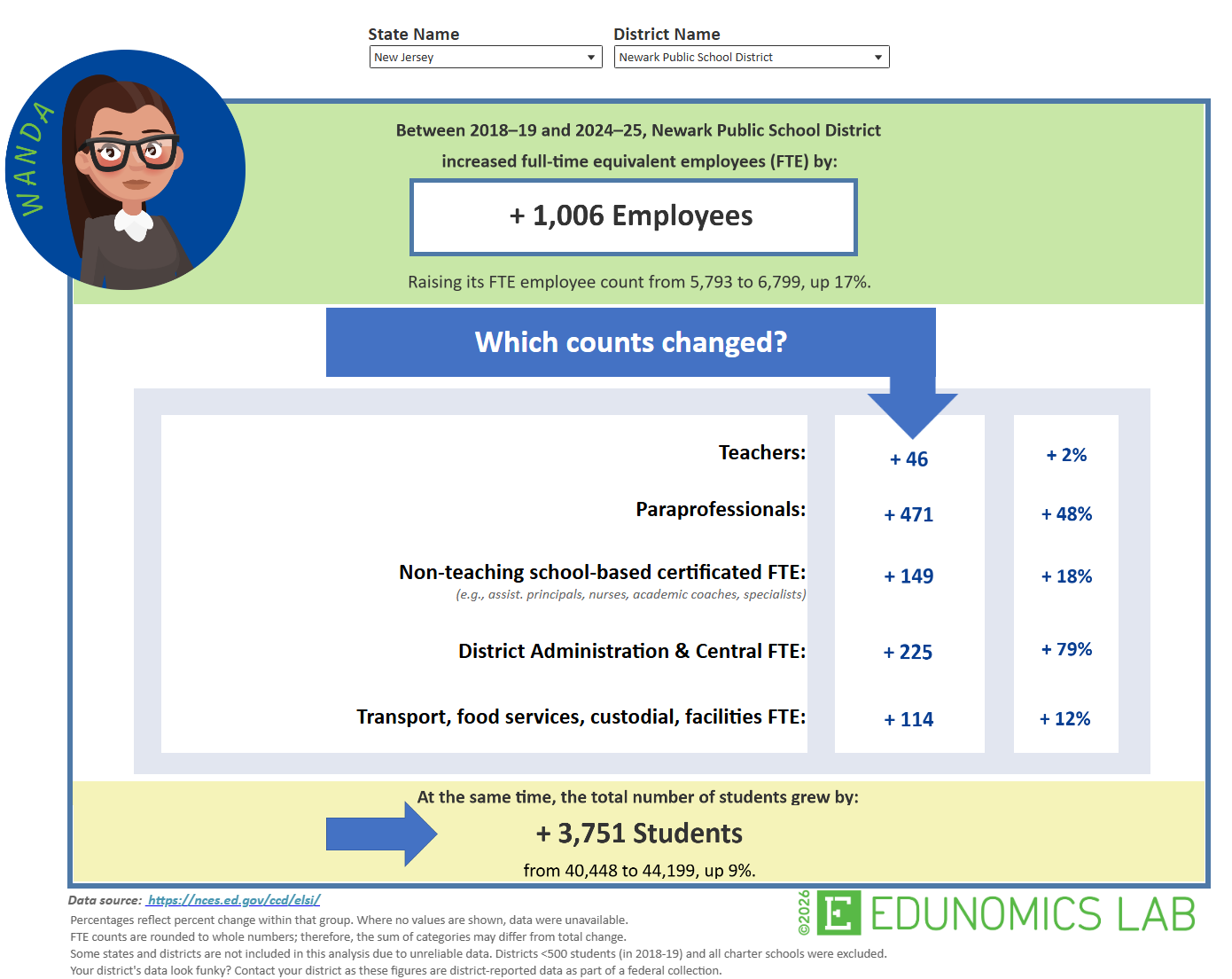
The database only goes through school year 2024-2025 so let’s make an adjustment to calculations based on the news of NPS’s loss of enrollment. You can see from the image below that over the six years tracked by WANDA, NPS increased its number of full-time employees by 17%, adding 1,006 staff members, courtesy of those federal emergency funds that ran out a year and a half ago. At the same time, student enrollment increased by 9%. Once you adjust for the loss of 818 students, NPS’s enrollment increased by 7%.
With a 17% increase in school staff, 10% more than the increase in student enrollment, you’d expect student learning to grow as well, especially with a per pupil cost of $27,000 per year. However, as TAPinto notes, only 34% of Newark students are on grade level in reading and 21% are on grade level for math, well below Newark’s thriving charter sector which educates one out of three city students. When Leon, who makes $319,785 a year, boasts the district was labeled “high-performing” by the state, that’s based on NJ’s quirky accountability tool called QSAC (Explainer here), which evaluates districts on compliance, not student proficiency rates. (Recently the DOE changed QSAC’s metrics for instruction to “growth” rather than grade-level achievement.)
Also worth noting: the bulk of Newark’s extra hires is in the category “District Administration and Central FTE [Full-Time Equivalent].” Edunomics calls this the “middle layer,” mostly “lots of talented teachers who got promoted to a coaching, AP, or specialists’ role,” and in NPS that number went up by an astounding 79% for an extra 225 positions. The smart move, Edunomics advises, would be to put these great educators back in the classroom, even if that means letting them keep their pay increases.
Leon can boast as much as he pleases. His district is in a bind, with nine schools labeled “low-performing” and “identified for either comprehensive or targeted support.” Meanwhile last November the School Board, according to NJ Spotlight, “extended its superintendent’s contract in the middle of the night without public comment,” to the dismay of community members.
“The wanton disregard by the Newark school board for just the base level of normal, ethical, transparent behavior is amazing,” said Sen. Declan O’Scanlon.
At one Newark high school, Chancellor Avenue, 23% of students meet expectations in reading and 12% meet expectations in math. Superintendent Leon had the district hang a banner in the front of the school building declaring it a “Rising Blue Ribbon School.”
Will Leon transfer some of those “middle level” Covid hires into classrooms so students like those at Chancellor Avenue get a chance at a successful life? Will the School Board find a spine? Here’s hoping.




1 Comment
Isn’t it long past time to take a hard-eyed look at NJ’s public education system and do something serious to improve it? Why don’t we start with the state education authorities, since ultimate responsibility for assuring that students actually receive a thorough and efficient education rests with them?
The State can’t seem to decide whether it’s going to increasingly keep hands off, disclaim the power and duty to do anything meaningful for local school districts, and blame them for any educational shortcomings, or go nuclear and take over direct operation of the entire school district as it suddenly is trying to do in Lakewood.
Why don’t we insist that the new commissioner and her staff comprehensively and meaningfully evaluate how the School Funding Reform Act is actually working in practice for every district. In 2009 when the NJ Supreme Court permitted SFRA to go into effect, it did so on the explicit conditions that SFRA be fully funded every year and be periodically evaluated to ensure that it is working at its “optimal level” for every district. It has rarely met the first condition and never met the second.. Perhaps the State should even require that SFRA’s “adequacy budget” and “Local Fair Share” are required so that 30-40% of NJ’s school districts are not spending less than their statutorily defined adequacy budget levels. Requiring that the money is well spent should go without saying but may need to be shouted loudly. In that regard, a meaningful state oversight and evaluation system needs to be implemented.
.is that a lot to expect? Absolutely. But if we care about our children and our State can we do any less?