


NJCTL Approval by Workforce Registry Opens Tuition-Free Pathto P-3 Certification for Eligible N.J. Early Childhood Educators
August 21, 2026
Lakewood Loses Most of A Private School Voucher. Can Sherrill Say Yes to a Public School One?
August 26, 2026Your Kid’s School Board Isn’t Supposed to Have a Party
Eliza Schleifstein is a longtime resident and taxpayer of Randolph, NJ. She is the mother of two daughters who both attended Randolph Township Schools from kindergarten through graduation. She writes and comments on local education, with a focus on school district transparency and spending.
Recently, the school board president in my town, Randolph, used time during a public meeting to weigh in on a national political controversy that had nothing to do with our school district. In fact, the impetus for her speech was something that happened in another town. It raised a question that I hadn’t stopped to ask before: why are New Jersey’s school boards nonpartisan to begin with? Why isn’t a candidate required to declare a party when they run for a school board seat? Why are school boards not supposed to make decisions based on the personal political views of their members?
Look at the ballot the next time that you vote for school board. No “D.” No “R.” Just a name and maybe a three-word slogan.
That blank space next to the candidate isn’t an oversight. It’s the result of more than a century of deliberate design – and right now, it’s being tested from both directions. Board members up and down New Jersey are trashing it, one public speech at a time. And voters are answering in kind, picking candidates based on the party to which they suspect a nonpartisan candidate actually belongs.
New Jersey has held nonpartisan school board elections since the Progressive Era, more than 100 years ago, when reformers decided that a party boss had no business picking who runs the local schools. Forty-one states still agree. The theory was blunt: there is no Republican way to patch a gym roof and no Democratic way to figure out how many five-year-olds fit in a kindergarten classroom. That’s not a nicety. That’s the whole point.
And it’s under quiet assault.
A Structure Built for the Job, Not the Fight
Consider what a board of education actually does in a calendar year. It sets a budget and tracks it against enrollment and state aid. It hires and evaluates a superintendent. It approves curricula. It approves the fixing of boilers, HVAC systems, buses, and leaking roofs and enters into contracts with teachers’ unions and those who provide services to the school district. It sets the broad policies for the school system and the rules that the students must follow.
None of that sorts along party lines. Most of it demands the opposite – compromise and consensus. Bond referenda and tax questions don’t pass on a bare partisan majority; they need buy-in that crosses whatever other lines may divide a town.
A board wired to reward tribal loyalty over local judgment is one built to fail at its own job.
The ballot is only half the design. New Jersey law backs it up with an obligation: once elected, a board member governs for the whole district- not just the households who voted for them. That’s not a suggestion. It’s the deal.
When the School Board Is the Messenger – and When It Isn’t
Here’s the part nobody wants to hear: a lot of what’s blowing up school board meetings right now isn’t the board’s fault. Nor is it even the board’s call in the first place.
Take health education. New Jersey’s Student Learning Standards for Comprehensive Health and Physical Education – the standards that spell out what kids learn about consent, mental health, and sexual health, by grade band – are written and adopted in Trenton, by the State Board of Education (appointed by a governor who does belong to a political party and was elected as that party’s candidate). A local school board doesn’t write these standards or, in fact, have input into them or anything else to do with them. A local school board can’t repeal them or decide that their school district simply isn’t going to follow them. Districts choose their own curriculum and materials within those standards, and parents have a real escape hatch, the State’s Parents’ Right to Conscience Act.
But the requirement that the topic gets taught at all? That’s not on your local school board’s desk. It’s all Trenton’s call.
Same story with the use of cell phones in the schools. Governor Phil Murphy’s “bell-to-bell” law, signed in January 2026 (right before his second term ended and he left office for good), forces every school district to adopt a policy restricting non-academic phone use for the entire school day, starting in 2026-27. Nonnegotiable. Not a local school board decision.
What your local school board actually controls is the mechanics of how the law applies on a practical, day-to-day basis in your own schools. This means pouches vs. cubbies vs. lockers, and how to handle a kid who needs a phone for a medical device, an IEP or a translation app. It doesn’t mean whether your child can take out their iPhone during lunchtime.
If you’re furious about the phone law itself, fine: That’s a legitimate grievance and I feel it too. As much as I think that phones can be a distraction in school, a camp friend of one of my daughters was killed at Parkland and, from that day on, I made sure my daughters carried their phones so they could reach me in an emergency. I understand why a parent doesn’t want that lifeline taken away. But that anger is aimed at the wrong building. Voting out the board members who picked the storage method doesn’t touch the statute. Changing the law means changing state policy. Write to your State Senator or Assembly member, or to Governor Mikie Sherrill. Don’t write to your school board.
Confusing a local school board member for the author of a Trenton mandate is exactly how a nonpartisan local race gets hijacked into a proxy war over statewide politics, precisely the outcome the whole system was engineered to prevent.
If the policy is the problem, the fix runs through the Legislature or the State Board of Education. Not through a school board election.
But Then There Is the Board Member who Just Makes Things Worse
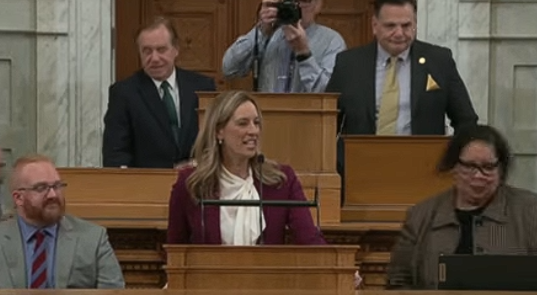
It’s the school board member who turns their time during Board Member Comments or, worse yet, during a discussion about an actual agenda item, into a monologue on whatever national fight is trending that week: immigration enforcement, vaccine mandates, gun control, gender issues, and other culture-war grievances that have nothing whatsoever to do with the district’s budget, staffing, facilities, or instruction. This is the same speech I mentioned earlier: our school board president spent several minutes standing on a political soapbox and ranting about immigration enforcement taking place in another town – a subject with no connection to her position as our board’s presiding officer.
Nobody in Trenton ordered that speech. No statute compelled it. It was a choice, a personal decision to treat a nonpartisan public office like a megaphone. And that choice is the difference between having political opinions and hijacking an otherwise non-partisan office to broadcast them to a captive audience.
A school board member is allowed to have personal opinions and convictions. What the job demands is the discipline to know that the dais isn’t theirs to commandeer for whatever’s on their mind at the moment. The role isn’t to represent a political party, a movement, an ideology, or a hashtag. It’s to represent every child, every family, every teacher and every taxpayer in the district, including the ones who didn’t vote for you and don’t share your political views. Sometimes that means shutting up.
And this is exactly where voter accountability belongs. A school board member who uses the dais to expound on their own political views doesn’t belong on the board. That’s the member who should be voted off, not the board member accused of “doing the State’s bidding” by implementing the laws that Trenton enacted to govern the schools. One of these board members broke the deal. The other one was just doing the job.
Nonpartisanship Protects Consensus and Competence
New Jersey doesn’t just hope that school board members behave. It legislates it. The statutory Code of Ethics for School Board Members requires members to “confine my board action to policy making, planning, and appraisal” and to “refuse to surrender my independent judgment to special interest or partisan political groups.” That’s not a mission statement hanging on a wall somewhere but part of the literal language of N.J.S.A. 18A:12-24.1, enforceable by the School Ethics Commission.Both halves of that promise, however, frequently get broken in practice, in two different ways.
The first failure is when a school board member spends their comment time on issues like immigration enforcement in another town. When that happens, the board member isn’t just delivering an awkward speech: She is potentially surrendering her independent judgment to a partisan fight that has nothing to do with the district. And when a school board president turns her office into a vehicle for a personal vendetta against a colleague, she isn’t confining her action to policy making, planning, and appraisal either. Your political convictions are yours to keep. The office belongs to the district.
The second failure also isn’t hypothetical. It’s exactly what’s playing out right now in Randolph, where our board president and another sitting board member are at open odds with one another. The school board president has allegedly yelled obscenities at the other board member during closed session. She has repeatedly withheld information from him that he needed to do his job. And she put her intentions in writing, telling him she was going to “suffocate him with my silence” and refuse outright to answer any of his questions. That’s not independent judgment exercised on behalf of the district. That’s a public office turned into a personal weapon through which to carry out a private feud.
There’s a practical payoff to keeping both halves of that promise, not just a legal one. Research on school board effectiveness ties alignment among board members around shared achievement goals to actual gains in student outcomes. Boards that function as a unit outperform boards that function as a shouting match and right now Randolph’s board is spending its energy on a feud instead of that alignment. Every minute spent on a personal issue or political concern, or nursing a grudge, or wielding silence as a weapon, is a minute not spent on the work our kids actually need done.
Party Labels Help at the Ballot Box, Hurt at the Dais
The pro-party argument sounds reasonable on its face: Labels give low-information voters a shortcut, and a shortcut might push voter turnout in elections that usually draw a sliver of eligible voters. Fair enough, as far as it goes.
But making an election easier to navigate and making a school board better at governing are two different projects, and conflating them is the sleight of hand at the center of the whole argument.
Party labels don’t make board members more responsive to their neighbors. They make board members more responsive to their party. Those are not the same.
A parent asking about reading instruction, special ed services or a bus route doesn’t care whether the board member is a Democrat or a Republican. They care whether that board member actually understands the issue, asks the hard question, and is willing to think for themselves instead of checking a party line.
Nobody’s claiming that school board members don’t or shouldn’t have political opinions. Of course they do. Research on nonpartisan boards nationally shows most members already skew toward whatever party dominates their community, label or no label. Nonpartisanship was never a plan to erase politics from the people who serve. It was a plan to keep the machinery of party politics – primaries, official slates, top-down discipline and selection of community leaders, litmus tests – out of a process graded on student achievement, not ideological purity.
The Guardrail Only Works If You Use It
The guardrail is nonpartisanship itself – the blank space next to a candidate’s name, backed by a state ethics code that requires independent judgment over party loyalty. It’s not a wall. It doesn’t stop bad behavior by itself. It just strips the formal machinery of party politics out of a job that was never built to run on them.
The hard part doesn’t live in the statute. It lives with the people sitting at the dais, meeting after meeting, having to remember that the seat belongs to the district, not to whatever cause, ideology, or party they personally carry into the room.
That’s not a call for silence. It’s not a call to avoid controversy, rubber-stamp the superintendent, or nod along with every administrative recommendation. Quite the opposite: School boards need members willing to ask hard questions, challenge bad calls and scrutinize every line of the budget.
But there’s a hard line between independent judgment and partisan performance. Between disagreement and division. Between representing your constituents and using their meeting as your own selfish platform.
Nonpartisanship was never a promise that school boards would be free of conflict. It’s a framework built to stop party politics from becoming the organizing principle of how your kid’s school gets run. Everything past that, including how board members actually behave once they’re seated, is on the people who hold the seats.
Every meeting, every vote, every time a board member picks up the microphone, the same test applies: Use the office to advance a personal agenda or leave the agenda at the door and do the job the district elected you to do.
That’s the real meaning of nonpartisanship. And it only holds if voters enforce it. Every time we reward a board member for grandstanding, feuding with perceived members of the “other side,” or playing politics instead of doing the job, we melt the guardrail away – usually without realizing that’s what we just did. For the kids sitting in those classrooms, and the taxpayers footing the bill, it’s a guardrail worth defending. That starts with paying attention to how a candidate actually behaves once they’re in the seat, not just what they say to get elected to it.





1 Comment
Great article! A great explanation of how things should work. Any educator knows how hard it is to actually teach kids effectively these days, they don’t need partisanship from the school board making things harder. That’s why I’m running for US Congress as a common sense independent. We need less partisanship across the board and more working together to get things done.