

Should Gov. Sherrill Opt Into New Federal Scholarship Program? NJPI (and I) Have Some Thoughts.
October 5, 2026Who Calls the Shots in NJ: Mikie Sherrill or NJEA?
Andrew Sidamon-Eristoff, a former New Jersey State Treasurer, has a great piece in NJ Spotlight explaining how we got to the point that school districts are cutting staff and programs and raising property taxes due to soaring healthcare rates— up 34% just this year.
While there are fiscal reasons for the jam we’re in, Sidamon-Eristoff says the main reasons are political: In 2011 during the Christie Administration the State Legislature passed a bipartisan agreement called Chapter 78 that tied teacher premium contributions to salaries (the more you make, the more you contribute, moving from just 1.5% of salary to a phased-in sliding scale of 3% to 35% contributions to premiums ). But that system got scotched because “the union secured an explicit promise of support for ‘Chapter 78 relief’ from a Wall Street financier named Phil Murphy then running for governor. The teachers union’s early endorsement undoubtedly helped the relatively unknown Murphy clear the field of better-known candidates.”
In 2020, in Murphy’s third year, Chapter 78 was replaced by Chapter 44, which ended the “more you make, the more you pay” system, forcing districts to pick up far more of the costs. Sidamon-Eristoff calls this “a total capitulation to the NJEA’s demands [that] has made it virtually impossible for New Jersey’s school districts to manage health care costs rationally.”
Just how generous are NJEA members’ healthcare plans? Currently “the state’s consultant projects a 2026 annual plan cost of $37,490 per active employee in local school districts, which is 88% higher than its New Jersey market benchmark of $19,940…As a practical matter, the law requires them to offer the equivalent of a Mercedes GLE 350, even when a Honda CR-V might provide adequate coverage at substantially lower cost.”
Read the whole piece for other important insights about how NJEA lobbyists control law makers and, as a byproduct, hurt their members in order to increase political power.* (Remember, teachers also pay property taxes and send their kids to school.) Yet there is a corollary, also attributable to union leaders’ use of Murphy as their personal marionette: the demise of a series of educational advances made in 2012 during the Christie Administration that raised standards for students and teachers and increased equity in school placements for low-income families.
In 2015 the U.S. Congress enfeebled federal consequences for poorly-performing schools by adopting a (largely) toothless education law called Every Student Succeeds Act, which got states off the hook for the (aspirational and punitive) measures of No Child Left Behind. No sticks or carrots, plus barely-there accountability. Proficiency rates around the country started to go down. But not in New Jersey, where we stuck with the Common Core (a set of core concepts and essential skills kids need to to advance academically), just gave it a new name; adopted aligned standardized assessments called PARCC; and authorized and expanded high-performing charter schools. The result? New Jersey’s school system really was one of the best in the country.
Example: In 2015, on the test called NAEP, also known as “the Nation’s Report Card ,” right after ESSA went into effect, 4th graders across the country went down in math proficiency but New Jersey went up (just by 2 points, but still significant). In reading, US 4th graders went down one point, resulting in a 37% proficiency rate; in NJ, 4th graders went up 4 points in reading, with a proficiency rate of 49%.
Enter Phil Murphy and a set of educational decisions by his Administration that started to undermine our students’ academic growth. In deference to NJEA leaders, he chose the embodiment of lowered standards and accountability for his commissioner (Lamont Repollet of 64 Floor fame) and over time the DOE set successively lower bars for proficiency. As another example, the Administration threw the ambitions of low-income families under the bus by instituting a moratorium on new charter schools approvals and expansions (here’s NJEA on the issue), relegating primarily low-income Black and Latino families to low-performing schools because they couldn’t afford to exercise NJ’s most common form of school choice, moving to better districts.
While we had maintained our high status for a few years after ESSA took effect, we lost that edge because the DOE stopped acting as a backstop for a flaccid federal law..
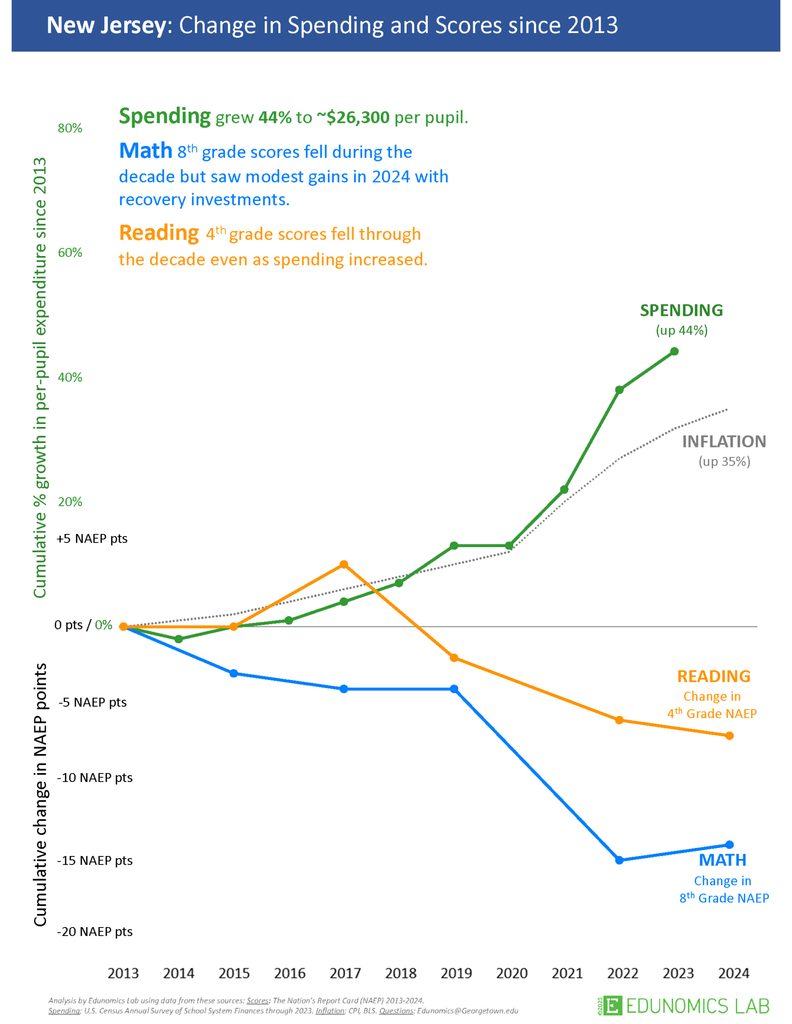
Here is a chart from Edunomics Lab that shows how student growth in reading peaked in 2017 and then plunged, — before the impact of unnecessarily long school closings, also on NJEA’s scorecard. (Math was flat until covid. )
Gov. Mikie Sherrill has acknowledged things need to change, not just the funding formula but also teaching and learning. In a speech in Newark in May she pointed out that third-grade Mississippi students score higher in reading than our low-income students, despite the state spending more than twice as much per pupil: “It shocked me … that alone should tell us that something needs to change here.
“Unfortunately,” Sherrill continued, “we are not seeing the schools keep up now with our great reputation.”
Does she have the wherewithal to go toe-to-toe with NJEA leaders? The answer will determine whether we start valuing our children over making concessions to power-hungry union leaders.
*Joel Klein, former NYC schools chancellor, had an op-ed on Sunday in the Wall Street Journal where he quotes Albert Shanker, founder of AFT, NEA’s sister union. In a 1993 speech before the Pew Forum, Shanker said: “The key is that unless there is accountability, we will never get the right system. As long as there are no consequences if kids or adults don’t perform, as long as the discussion is not about education and student outcomes, then we’re playing a game as to who has the power.”